
Michigan's Secure Storage Law

Michigan's Secure Storage Law

As required by Michigan state law, L'Anse Creuse Public Schools provides families with important information about safe firearm storage practices to help protect children in our community.

Michigan law requires secure storage of firearms when minors may be present. This includes storing firearms in locked containers or using locking devices to render them inoperable when children could have access to them.

Key requirements:

  • Firearms must be stored securely when minors may be present.
  • Secure storage includes locked containers or locking devices that render firearms inoperable.
  • The law is designed to prevent accidental access by children and reduce the risk of firearm-related injuries.

Annual Notice Requirement

State law compliance. Michigan law (Section 380.1313b) requires all schools to distribute firearm safety storage information to families annually, beginning October 1, 2025, and every October thereafter. This ensures that all families receive current information about safe storage practices and legal requirements.
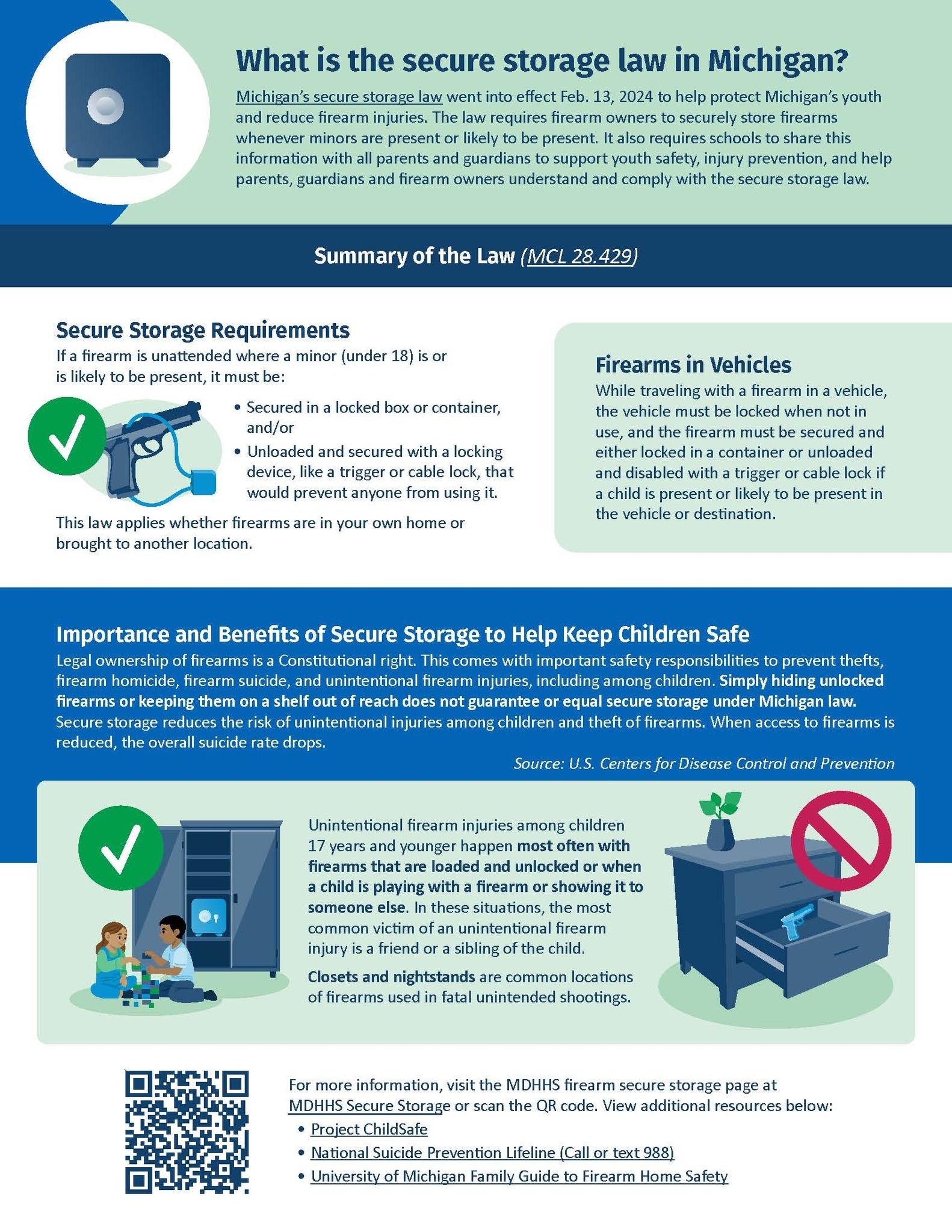
What is the secure storage law in Michigan? Michigan’s secure storage law went into effect Feb. 13, 2024 to help protect Michigan’s youth and reduce firearm injuries. The law requires firearm owners to securely store firearms whenever minors are present or likely to be present. It also requires schools to share this information with all parents and guardians to support youth safety, injury prevention, and help parents, guardians and firearm owners understand and comply with the secure storage law. Summary of the Law (MCL 28.429) Secure Storage Requirements If a firearm is unattended where a minor (under 18) is or is likely to be present, it must be: Secured in a locked box or container, and/or Unloaded and secured with a locking device, like a trigger or cable lock, that would prevent anyone from using it. This law applies whether firearms are in your own home or brought to another location. Firearms in Vehicles: While traveling with a firearm in a vehicle, the vehicle must be locked when not in use, and the firearm must be secured and either locked in a container or unloaded and disabled with a trigger or cable lock if a child is present or likely to be present in the vehicle or destination. Importance and Benefts of Secure Storage to Help Keep Children Safe Legal ownership of firearms is a Constitutional right. This comes with important safety responsibilities to prevent thefts, firearm homicide, firearm suicide, and unintentional firearm injuries, including among children. Simply hiding unlocked firearms or keeping them on a shelf out of reach does not guarantee or equal secure storage under Michigan law. Secure storage reduces the risk of unintentional injuries among children and theft of firearms. When access to firearms is reduced, the overall suicide rate drops. Source: U.S. Centers for Disease Control and PreventionUnintentional firearm injuries among children 17 years and younger happen most often with firearms that are loaded and unlocked or when a child is playing with a firearm or showing it to someone else. In these situations, the most common victim of an unintentional firearm injury is a friend or a sibling of the child. Closets and nightstands are common locations of firearms used in fatal unintended shootings.For more information, visit the MDHHS firearm secure storage page at MDHHS Secure Storage or scan the QR code. View additional resources below: Project ChildSafe, National Suicide Prevention Lifeline (Call or text 988), University of Michigan Family Guide to Firearm Home Safety
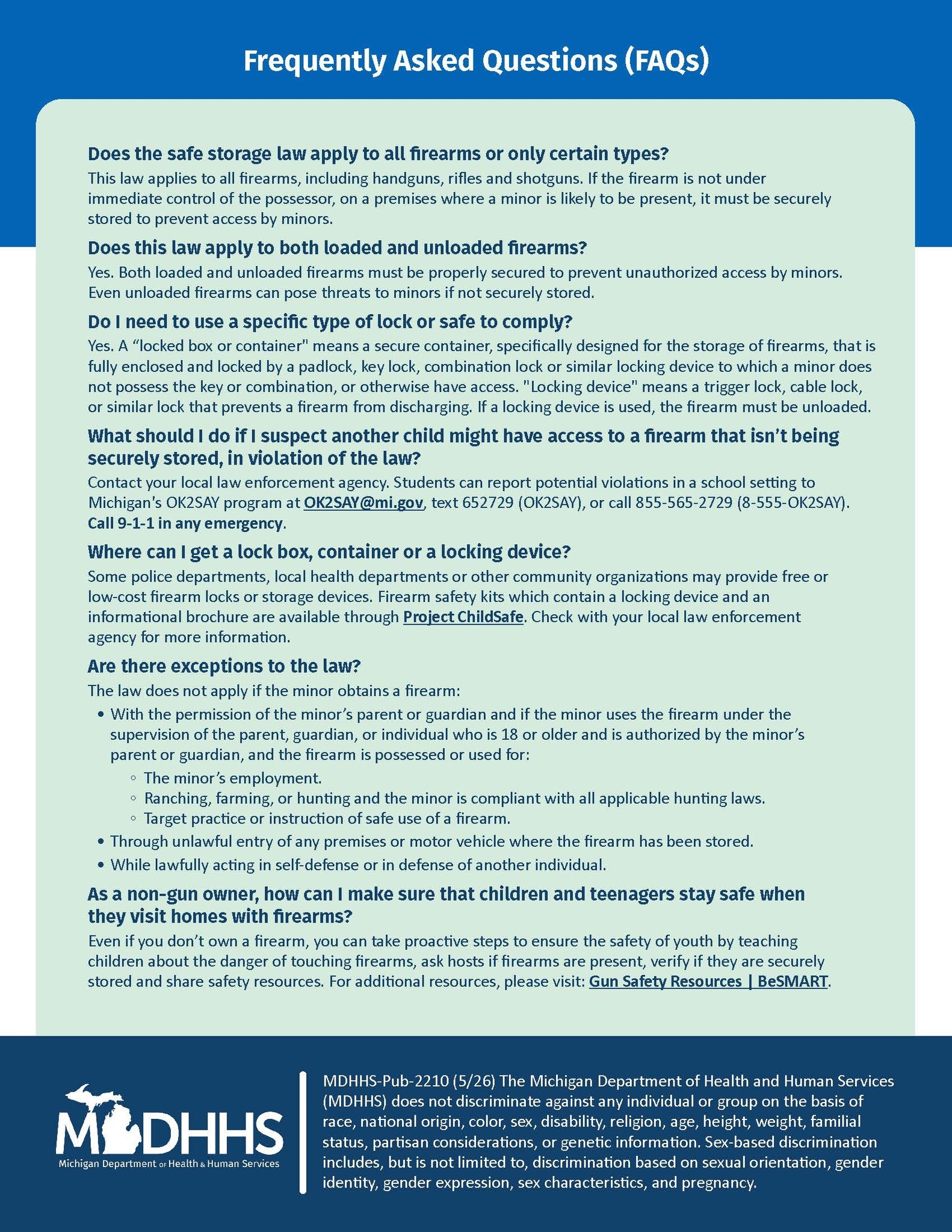
Frequently Asked Questions (FAQs) Does the safe storage law apply to all firearms or only certain types? This law applies to all firearms, including handguns, rifles and shotguns. If the firearm is not under immediate control of the possessor, on a premises where a minor is likely to be present, it must be securely stored to prevent access by minors. Does this law apply to both loaded and unloaded firearms? Yes. Both loaded and unloaded firearms must be properly secured to prevent unauthorized access by minors. Even unloaded firearms can pose threats to minors if not securely stored. Do I need to use a specific type of lock or safe to comply? Yes. A “locked box or container" means a secure container, specifically designed for the storage of firearms, that is fully enclosed and locked by a padlock, key lock, combination lock or similar locking device to which a minor does not possess the key or combination, or otherwise have access. "Locking device" means a trigger lock, cable lock, or similar lock that prevents a firearm from discharging. If a locking device is used, the firearm must be unloaded. What should I do if I suspect another child might have access to a firearm that isn’t being securely stored, in violation of the law? Contact your local law enforcement agency. Students can report potential violations in a school setting to Michigan's OK2SAY program at OK2SAY@mi.gov, text 652729 (OK2SAY), or call 855-565-2729 (8-555-OK2SAY). Call 9-1-1 in any emergency. Where can I get a lock box, container or a locking device? Some police departments, local health departments or other community organizations may provide free or low-cost firearm locks or storage devices. Firearm safety kits which contain a locking device and an informational brochure are available through Project ChildSafe. Check with your local law enforcement agency for more information. Are there exceptions to the law? The law does not apply if the minor obtains a firearm: With the permission of the minor’s parent or guardian and if the minor uses the firearm under the supervision of the parent, guardian, or individual who is 18 or older and is authorized by the minor’s parent or guardian, and the firearm is possessed or used for: The minor’s employment. Ranching, farming, or hunting and the minor is compliant with all applicable hunting laws. Target practice or instruction of safe use of a firearm. Through unlawful entry of any premises or motor vehicle where the firearm has been stored. While lawfully acting in self-defense or in defense of another individual. As a non-gun owner, how can I make sure that children and teenagers stay safe when they visit homes with firearms? Even if you don’t own a firearm, you can take proactive steps to ensure the safety of youth by teaching children about the danger of touching firearms, ask hosts if firearms are present, verify if they are securely stored and share safety resources. For additional resources, please visit: Gun Safety Resources | BeSMART.MDHHS-Pub-2210 (5/26) The Michigan Department of Health and Human Services (MDHHS) does not discriminate against any individual or group on the basis of race, national origin, color, sex, disability, religion, age, height, weight, familial status, partisan considerations, or genetic information. Sex-based discrimination includes, but is not limited to, discrimination based on sexual orientation, gender identity, gender expression, sex characteristics, and pregnancy.